Tuesday, 3 June 2008

Cars and Commuting

There has been some discussion at work about greening the workplace. There are lots of politically correct things to do like recycling paper and ink cartridges and using low-power laptops. Most of these things pale into insignificance however when compared with the impact of commuting to the workplace.

As a ball-park figure, a car needs about 1 Kilowatt-hour to go 5 miles. Even ignoring engine and drivetrain efficiency (lousy, especially for the first part of the journey in winter when the engine is cold), this still works out to a Megawatt-hour per day for 250 people doing 10 miles each way. There are several possible ways to reduce this.

  • Encourage home working, maybe following BT's lead and having people formally based at home and hot desking when they come into the office for meetings.
  • Apply pressure for better public transport links (minibuses to business parks from park-and-ride locations??)
  • Encourage care sharing/pooling
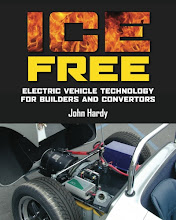
  • State a policy to provide electric vehicle charging points at work. Many of us could commute in currently-available electric vehicles if there was recharging at work.
Electric vehicles still burn power, but less of it and produced with:
  1. a greater range of energy sources other than oil (including renewables)
  2. greater thermal efficiency (a fixed power station is more efficient than the true lifetime efficiency of a car engine which some sources put below 5%)
  3. more efficient distribution (electricity is distributed by wires with a small loss compared with the additional fuel burn of petrol tankers)
  4. less atmospheric pollution (fixed power stations again)


Electric and plug-in hybrid vehicles have a further longer term emergent eco-system benefit. With the right control software a critical mass of electric vehicles nationally could be used to smooth power demand. At present a significant amount of generating capacity has to be kept on idle standby to cope with peaks and troughs in demand (e.g. everyone putting the kettle on at the start of cup-final half time). A million EV batteries could do the same job (the grid charges the batteries during play and borrows a bit back at half time)

Saturday, 10 May 2008

He who sits in the Heavens will laugh them to scorn

The God Delusion. written by Richard Dawkins (an Oxford academic) is an outspoken attack on religious faith in general and Christianity in particular. It is brilliantly written, although the actual content is sloppy and naive. One among many examples of this naivety is his handling of the story of Abraham being told to sacrifice Isaac, which Dawkins roundly condemns, in effect accusing Yahweh (the name often used for God in the Old Testament) of child abuse.

I have met many Western Christians who are also uneasy about this story. I think both are mistaken. They are attempting to interpret the text through their own cultural filters and failing to see it through the eyes of those about whom and to whom it was written.

We know that human sacrifice was widespread in the centuries before and soon after the Old Testament period.

  • In the ancient Near East the God Molech is described by many authors as consuming living babies.
  • Chemosh in Moab required the occasional human sacrifice.
  • The tomb of Queen Pur-Abi in Ur (the city from which Abraham had come) contained the remains of 5 soldiers and 23 ladies in waiting.
  • It is believed by some that Phoenicians and Carthaginians sacrificed children.
  • In the Americas, the Aztec, the Maya and the Inca almost certainly practiced human sacrifice.
  • There is evidence for it amongst the Celts and the Vikings,
  • and in India and China.

Now imagine the story of Abraham, not being read by an academic living at a time when human sacrifice has been outlawed for millenia, but being heard around the campfire by people to whom human sacrifice was the norm. To them, the really shocking thing about the story would not have been that Yahweh said "do it" (that is what gods did in those days) but that Yahweh subsequently said "stop".

And people, particularly people who do not have access to books, learn through stories. To a peasant who has grown up with human sacrifice, this is a story with an unforgettable punch line: a story worth a thousand finger-wagging admonishments. Here is a God on the point of getting the ultimate sacrifice from one of his followers saying "stop - I don't want it"

It is arguable that this story of Abraham and Isaac has actually been redundant for the last thousand years, having done the job God intended for it. The three Abrahamic religions have wiped human sacrifice, once so common, from the face of the earth. It is banned in every country on the planet and has almost completely disappeared from every culture. We cannot wind back and re-run history without Abraham, but it is a fair guess that this story which Dawkins so derides has played a part in that triumph.

Sunday, 20 April 2008

Below 50 Degrees South

The Southern ocean is one of the wildest and most inhospitable place on earth. There is an old saying that "south of 40 degrees south there is no law and south of 50 degrees there is no god".

In a 1996 single handed round-the-world race, Tony Bullimore went missing. One TV programme I saw about him at the time said that his wife, a Christian, organised prayer meetings on his behalf

To everyone's astonishment, a P3 Orion spotted the upturned hull of his yacht in the vastness of the Southern ocean. It had suffered a keel failure which had caused it to roll inverted. Bullimore survived in an air pocket in the capsized hull. Later an Australian destroyer rescued him after 5 days in the upturned hull.

The position of the rescue? 52 degrees south.

"... whither shall I flee from thy presence?..If I take the wings of the morning, and dwell in the uttermost parts of the sea;..Even there thy right hand shall hold me."

Saturday, 15 March 2008

Contempt and Idolatry

In the 18th Century, Lord Chesterfield once wrote to his son "Speak of the Moderns without contempt and the Ancients without idolatry"

Our danger is the reverse: to idolise contemporary celebrities and to pass judgement on the wisdom and scholarship of the past on the basis of our vague and tawdry moral code

Friday, 14 March 2008

Green posturing?

How many of our green priorities are just posturing, and how much is tied to real benefit to real people? A few months back, I read an article on green laptops (the key issue being power consumption).

This is just daft. The power used by a laptop is a minute fraction of the power consumed in a typical office day. A typical laptop consumes between 7 and 30 watts depending on load. Even if I used my laptop for 8 hours at the higher figure, that is about 0.25 k.watt-hours in a working day.

My daily commute consumes at least thirty times that. It's about 40 miles/day and takes about an hour. My car probably uses about 10 HP in cruise. That is about 7.5 k.watt-hours a day ( I am making the assumption - generous to the laptop - that my car engine is about as efficient as a fixed power station at turning fuel into usable power)

Many authorities suggest that dropping your cruising speed from (say) 65 m.p.h to 60, increasing your tyre pressure, or lowering the weight of the car saves a significant percentage. If you do the arithmetic, only filling your fuel tank half way (to keep the weight down) would probably do more real good than swapping the worst laptop for the best. If you combined that with dropping your cruising speed 5 mph, and/or timing your commute to avoid peak traffic, you would blow any possible laptop power savings into the weeds.

You could do similar calculations on office heating and probably even the power consumed by the office kettle or in the staff canteen. Laptop power consumption is a drop in a bucket. There are far bigger wins that are easier and cheaper.

Monday, 10 March 2008

Not a little KNOWLEDGE but a little LEARNING

One of the most frequently misquoted sayings in English must be Alexander Pope's "A little learning is a dangerous thing..". It often becomes "A little knowledge is a dangerous thing...".

The two are most emphatically not the same. A little knowledge in the hands of a learned man or woman is perfectly safe and usually helpful. Great knowledge in the hands of someone of little learning is a recipe for arrogance.

Friday, 29 February 2008

Tonal Languages

Chinese (at least Mandarin, the most common dialect) is a tonal language. That is the the difference between a rising and a falling tone completely changes the meaning of a word. So for example, a sharp "shh" sound means "is" - if the tone is falling (like a steam locomotive on a gradient). On the other hand it can mean "poem" if the tone is level (like shushing a child whispering during a film). If the tone rises it means "ten".

English on the other hand is not tonal - or is it? The meaning of the word "Really" for example changes radically with the tone. With a falling tone it conveys scepticism or unbelief. A rising tone conveys interest or surprise.